A Small Voice on a Big Stoop
I keep saying I embrace my insignificance. So why do I keep asking people to read what I write?
By Jose Franco
I have developed a habit of reminding myself that I am insignificant.
I don't mean that in the sad, staring-at-the-ceiling-at-3-a.m. sense. I find the thought strangely liberating. History is unlikely to remember my opinions. The republic will survive without my policy recommendations. No future economics department is likely to organize a symposium around something I wrote on Stoop Juice.
This realization should make it easier to listen, harder to take myself too seriously and nearly impossible to confuse disagreement with disrespect.
There's only one problem.
I won't shut up.
I write books. I write essays. I make videos. I host conversations. I put the books online for free and then tell people where to find them. I redesign the website so they're easier to discover. I occasionally promote something I have written while simultaneously explaining that I don't particularly care about promoting myself.
At some point, intellectual honesty requires acknowledging the comedy.
If I truly embraced my insignificance, couldn't I write all this in a notebook, put it in a drawer and spare everyone the trouble?
Probably.
Instead, I created Stoop Juice.
And that contradiction has become more interesting to me than pretending I've resolved it.
I tell myself that I publish because I want conversation rather than attention. That is mostly true. But "mostly" is doing some work there.
Of course I want people to read what I write. Otherwise I wouldn't publish it. Of course some part of me enjoys discovering that an idea resonated with someone. I am not somehow exempt from the ordinary human appetite to be noticed, understood or occasionally told, "That's an interesting way of looking at it."
The danger begins when wanting to be heard quietly becomes needing to be right.
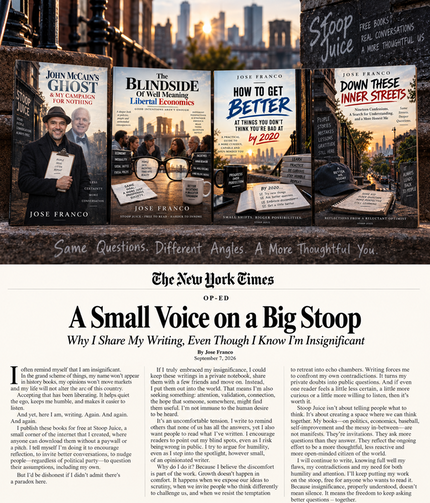
That's the tension I've been trying to explore in books with titles like The Blindside of Well-Meaning Liberal Economics, John McCain's Ghost & My Campaign for Nothing, How to Get Better at Things You Don't Think You're Bad At by 2020 and Down These Inner Streets.
The titles change. The person I'm interrogating usually doesn't.
It's me.
Even when I'm writing about politics or economics, I increasingly suspect that I'm writing about the psychological machinery underneath them: certainty, identity, tribalism, ego and our remarkable ability to identify contradictions everywhere except in ourselves.
That is also why I make the books free.
I'm not asking anyone to buy my conclusions. I'm not even particularly interested in selling the conclusions metaphorically.
I'd rather someone read something I wrote and say, "Jose, you're missing something."
Better yet: tell me what.
That invitation sounds wonderfully enlightened until somebody actually accepts it.
Then the real experiment begins.
It is easy to celebrate open-mindedness when the other person hasn't finished explaining why you're wrong. It is harder when the criticism touches an idea you have spent months developing—or worse, an idea that has quietly become part of how you see yourself.
Growth sounds beautiful in retrospect.
During the actual renovation, there is dust everywhere.
I would like to tell you that I consistently welcome that discomfort. I don't. Sometimes I become defensive. Sometimes I construct an answer while someone is still talking. Sometimes I confuse having considered another perspective with having genuinely allowed that perspective to threaten my own.
Then I catch myself.
Sometimes.
Perhaps that is progress.
My book criticizing well-meaning liberal economics isn't intended as an invitation to conservatives to congratulate themselves. A conservative reader should be examining his assumptions, too. My writing about John McCain isn't an argument that political virtue belongs to Republicans. And my writing about self-improvement would be absurd if its author believed improvement was primarily something other people needed.
The common thread isn't ideology.
It's suspicion of certainty—including mine.
American political culture increasingly rewards the opposite instinct. We are encouraged to announce what we believe before investigating why we believe it. Social media makes changing your mind look like weakness and confidence look like competence. Political identity can turn curiosity into betrayal.
Yet democracy requires something considerably less glamorous: citizens willing to entertain the possibility that people they disagree with may occasionally see something they don't.
That doesn't require abandoning convictions. Some ideas are better supported than others. Some policies produce better outcomes. Some arguments deserve vigorous opposition.
Humility isn't intellectual surrender.
It is simply leaving enough room in your certainty for reality to surprise you.
So I will probably keep writing.
I will keep giving the books away. I'll keep asking people to read them. I'll keep claiming that I embrace my insignificance while behaving suspiciously like a man who would very much appreciate your attention.
I see the contradiction.
Maybe recognizing it doesn't absolve me of it.
Maybe that's not the point.
Perhaps embracing insignificance doesn't require silence. Perhaps it means speaking without imagining that speaking makes you important—and listening without assuming that being challenged makes you smaller.
Or perhaps that's another flattering story I'm telling myself.
If so, there's an easy remedy.
Point out the blind spot.
I'm still learning how to look.